Scientific Share of Voice: A Complete Guide
for Life Sciences Teams
Scientific Share of Voice (SSoV) is an
evaluation of a brand’s scientific impact.
It helps life sciences organizations
understand how their therapeutic products,
research, experts, and evidence compare with
peers across therapeutic areas. This guide
breaks down what scientific share of voice means, why it applies across pharma, biotech, medtech,
diagnostics, and animal health, and how teams
can measure and improve it.
Monday, July 6, 2026
What is Scientific Share of Voice?
Scientific share of voice is the proportion of
scientific conversation, impact, presence, and
credibility your organization holds within a given
therapeutic area or specialty, relative to your
competitors and peers.
Unlike traditional Share of Voice, which focuses on
impressions, mentions, or advertising visibility,
Scientific Share of Voice measures an organization's
presence and influence within the scientific community.
It brings together insights from relevant scientific
channels and activities to provide a holistic view of
scientific visibility, engagement, and impact across a
therapeutic area.
Scientific excellence alone does not
guarantee scientific influence.
Organizations need to understand whether
their research or therapeutic products
are reaching the right experts, being
discussed in the right forums, and
shaping conversations within their
therapeutic areas. Scientific Share of
Voice (SSoV) provides that visibility.
SSoV helps organizations measure their scientific
presence across scientific communities and channels, giving a more complete picture of how
their research compares with competitors. A strong Scientific
Share of Voice enables organizations to:
1. Benchmark scientific visibility against
competitors within specific therapeutic areas.
2. Measure the impact of evidence-generation
efforts.
4. Detect gaps in scientific presence across
regions, specialties, or research topics.
5. Track changes in scientific influence over
time to understand whether visibility is growing
or declining.
6. Gain insights into the clinical trial
landscape across your therapeutic area.
7. Support data-driven planning for KOL
engagement.
8. Strengthen scientific positioning by focusing
resources where they will have the greatest
impact.
Rather than relying on isolated metrics, Scientific
Share of Voice brings together multiple indicators into
a single report. This enables organizations to
understand not just how much scientific content they
produce, but how visible, influential, and competitive
their science is within the broader healthcare
ecosystem.
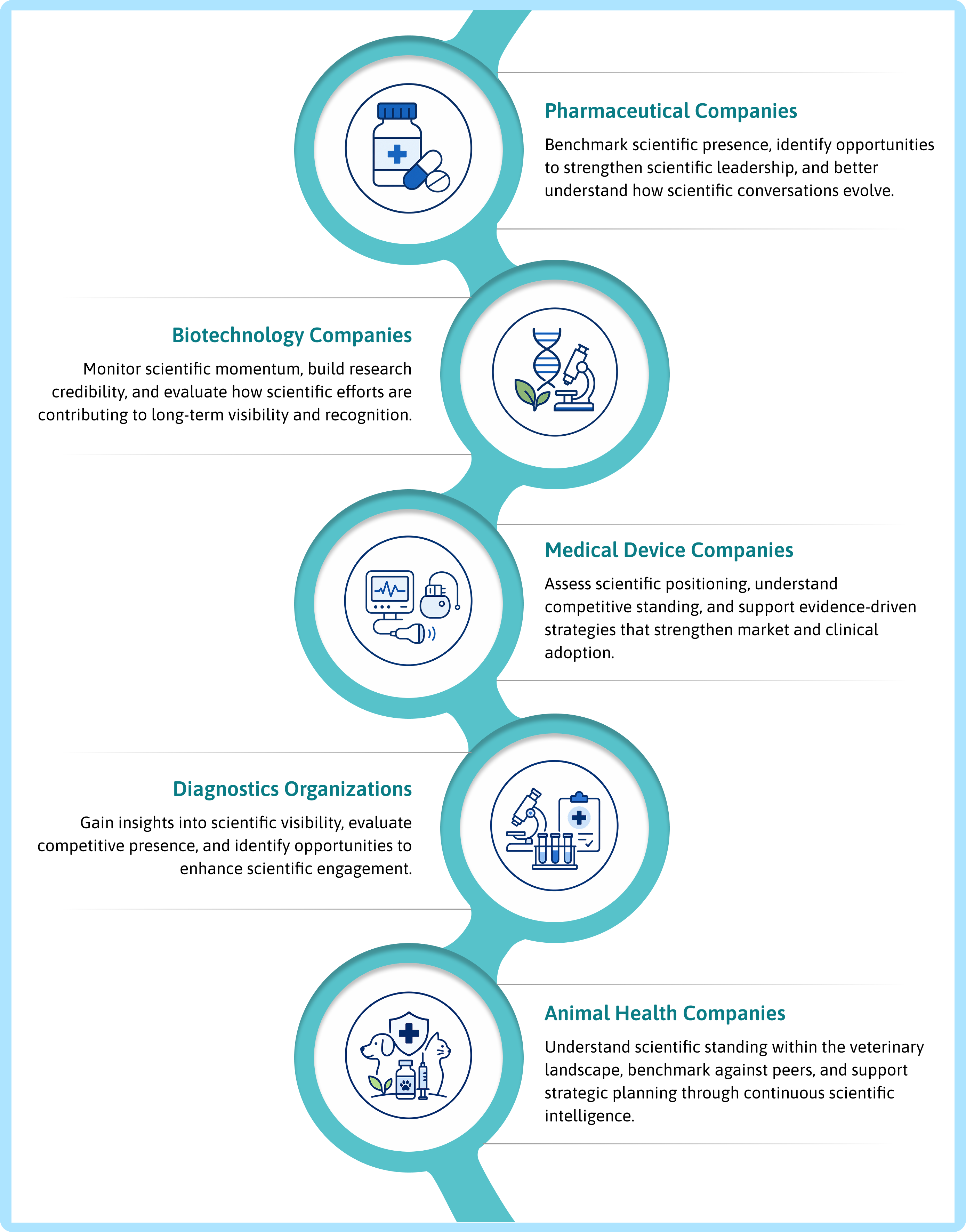
Organizations That Benefit from Scientific Share
of Voice
Scientific Share of Voice (SSoV) helps organizations
that rely on scientific credibility, KOL engagement, and
evidence-driven decision-making. It provides them the
insights needed to understand their scientific
positioning and make informed strategic decisions.
Establishing a meaningful Scientific
Share of Voice (SSoV) framework begins
with understanding how your organization
is represented across the scientific
landscape. A comprehensive approach
helps medical, commercial, and
scientific teams monitor scientific
visibility, benchmark against peers, and
identify emerging opportunities for
engagement.
An effective SSoV strategy should enable
organizations to:
1. Measure scientific visibility within their
therapeutic area.
2. Benchmark performance against relevant
organizations.
4. Track changes in scientific influence over
time.
5. Generate actionable insights that support
evidence-based decision-making.
Because scientific influence evolves continuously, Scientific Share of Voice should
be assessed on a regular basis to provide an up-to-date view
of your organization's scientific standing and competitive
landscape.
The Common Challenge: Fragmented Scientific
Intelligence
Life sciences teams typically pull SSoV-adjacent
data from several disconnected places. By the
time all of this is stitched together manually,
the intelligence is often outdated. This is
where a structured, ongoing approach becomes
useful, rather than a one-off benchmarking
exercise done once a year. And konectar SSoV
does exactly that, helping teams track scientific
share of voice of where your organization stands
scientifically.
How konectar Scientific Share of Voice Addresses
This
konectar Scientific Share of Voice (SSoV)
measures your organization's scientific
visibility across the channels that shape
scientific influence. It provides a unified view
of how your science is represented within your
therapeutic area and the industry.
Organizations across the world have leveraged
konectar Scientific Share of Voice to benchmark
their scientific visibility, uncover competitive
insights, and make more informed decisions.
Teams can easily request a customized Scientific
Share of Voice report tailored to their
therapeutic area, brand, molecule, or competitive landscape.
Because the underlying data is analyst-verified
rather than automatically aggregated, the
resulting picture reflects genuine scientific
standing rather than raw mention counts or
surface-level activity on any one channel.
Ready to understand your scientific
standing?
Request your customized Scientific Share
of Voice report today and gain
actionable insights into your
organization's scientific visibility.
Scientific Share of Voice measures how
visible a life sciences organization's
science is across various scientific
communities, channels and digital platforms, relative to competitors in the same therapeutic
area.
While KOL engagement tracking helps organizations manage and optimize interactions
with healthcare experts, Scientific Share of
Voice offers a higher-level view of an organization's
scientific presence, enabling teams to benchmark
their scientific standing and identify opportunities
to strengthen their competitive position.
Yes. Any organization that relies on
scientific credibility, expert engagement,
and evidence-driven decision-making can use SSoV to understand its scientific standing
and benchmark against peers within its therapeutic
area.
Most life sciences teams benefit from a
quarterly review, with a more detailed check
ahead of major congresses or significant publication activity in their
therapeutic area.